Ecosystem and Interoperability
(Protocols are plumbing; architecture is governance)
Agentic systems will not remain isolated. As soon as an organisation has more than one agent—or more than one tool integration—interoperability becomes inevitable. Agents will need to cooperate across internal teams, external vendors, and heterogeneous runtime environments. The question is not whether this will happen; it is whether it happens safely and coherently.
This section clarifies a critical distinction:
-
Interoperability protocols define how agents and tools communicate. They are plumbing.
-
Agentic architecture defines how those interactions are governed: identity, policy, budgets, verification, and observability.
The Agentic Architecture Framework is intentionally protocol-agnostic. It is designed to remain stable as protocols evolve—because the governance primitives do not change even as the plumbing does.
13.1 Tool Interoperability: MCP as a Standardized Tool/Context Interface
The Model Context Protocol (MCP) is a prominent example of standardizing how LLM applications and agents discover and invoke tools through a consistent client/server interface. The architectural consequence is immediate: standardization lowers integration friction and accelerates adoption—but it also increases the likelihood that agents will be deployed with broad tool access before governance is mature.
MCP also makes explicit several security constraints that align with this paper’s governance-first approach:
-
Tools represent arbitrary code execution and must be treated with appropriate caution.
-
Tool behavior descriptions (such as annotations) should be treated as untrusted unless obtained from a trusted server.
-
Hosts must obtain explicit user consent before invoking any tool.
Those protocol-level principles reinforce the framework’s pillar guidance: treat tool execution as actuation, treat external context as hostile by default, and ensure that authority to act is gated.
A practical implication for architects is that MCP is not merely an integration layer; it is also a governance surface. As MCP adoption expands, the need for strong tool allowlists, permission scopes, budgets, and verification gates becomes more—not less—important.
13.2 Agent Interoperability: A2A and the Next Trust Boundary
Where MCP focuses on tool integration, Google’s Agent2Agent protocol (A2A) is positioned to enable agents to communicate securely, exchange information, and coordinate actions across enterprise platforms and applications.
A2A-type interoperability shifts the trust model. Instead of a single agent interacting with tools, you now have:
-
agent identities and authentication requirements,
-
message-level prompt injection risks,
-
cross-agent context exchange as a potential exfiltration channel,
-
distributed budgets and distributed accountability, and
-
outcome verification across multiple cooperating components.
In short: A2A expands the architecture from “agent + tools” to “agent ecosystems.” That amplifies the importance of the cross-cutting foundations in this paper:
-
Context Optimization (because inter-agent communications are context inflow), and
-
Autonomy & Outcome Governance (because cross-agent requests can trigger real actions).
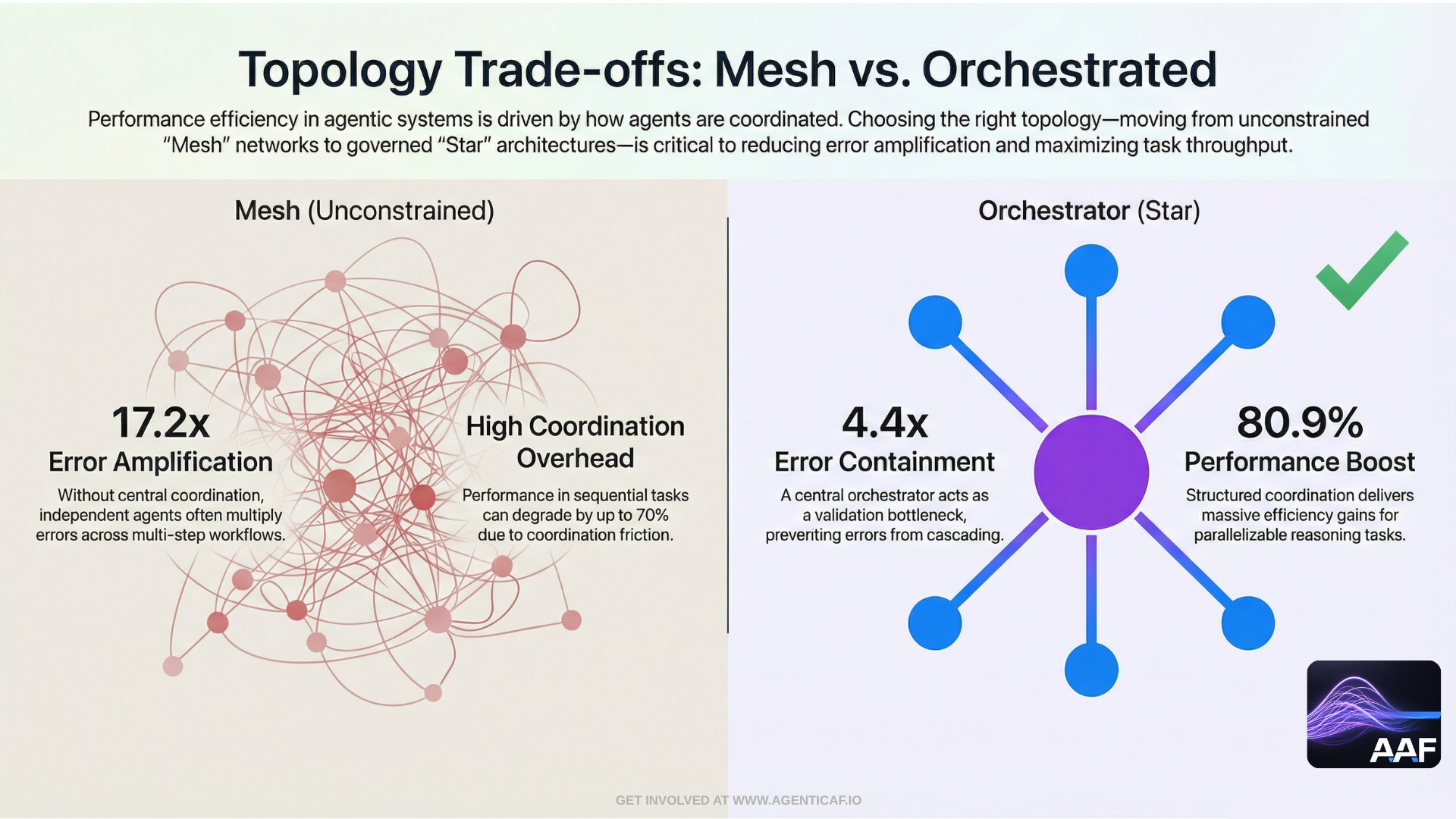
As interoperability rises, supervisory patterns become increasingly valuable: central orchestrators, validation bottlenecks, and explicit policy gates to prevent error amplification and prevent untrusted agent messages from becoming authoritative instructions.
13.3 Operational Interoperability: AGENTS.md as a “Contract” for Execution
Interoperability is not only about message formats. It is also about making execution environments legible to agents.
AGENTS.md has emerged as a simple, open format for guiding coding agents—effectively a predictable place to provide context and instructions, framed explicitly as a “README for agents.” This matters operationally because agentic systems failure is often due to environmental misunderstanding as due to model limitations: how to run tests, how to structure changes, where configs live, what not to touch, and how deployment should be staged.
OpenAI’s guidance for AGENTS.md describes it as a mechanism for layering global guidance with project-specific overrides so that coding agents start tasks with consistent expectations across repositories.
From a framework perspective, this is an operational excellence primitive:
-
it reduces variability and drift,
-
improves repeatability,
-
supports auditability (version-controlled instructions), and
-
makes governance constraints explicit and reusable.
13.4 The Architectural Positioning: Keep Governance Above the Protocol Layer
Interoperability is acceleration. Without governance, it is also amplification—of risk, cost, and operational complexity.
The Agentic Architecture Framework therefore takes a clear stance:
Protocols should be considered enabling infrastructure.
Governance primitives—identity, policy, budgets, verification, and observability—must sit above protocols and constrain how they are used.
This ensures that agent ecosystems remain operable and safe even as they become more connected.
Orchestration frameworks: runtime plumbing, not governance
In addition to interoperability protocols (MCP/A2A), the ecosystem includes orchestration frameworks that implement agent coordination mechanics—graphs, message passing, checkpointing, and interrupts. These tools can accelerate delivery, but they should be treated as runtime plumbing rather than governance.
In the layered model of this framework:
-
Orchestrators live in the Orchestration Layer (control-flow, state, interrupts, checkpoints).
-
Protocols live at the Interoperability/Integration layer (how tools and agents communicate).
-
Governance primitives (ACC, budgets, approvals, verification gates, audit) must sit above both and constrain their use via the Tool Gateway and OCC requirements.
Practically: adopt orchestration tools to avoid rebuilding coordination primitives, but keep enforcement and authority transitions anchored in the governance layer so the system remains safe even as orchestration technology evolves.
Section 13 Citations
-
MCP specification (security and consent principles).
-
Google A2A announcement (agent interoperability framing).
-
AGENTS.md project (README-for-agents framing).
-
OpenAI AGENTS.md guidance (layered instructions for agents).