THE AGENTIC ARCHITECTURE FRAMEWORK V1.3
Mission
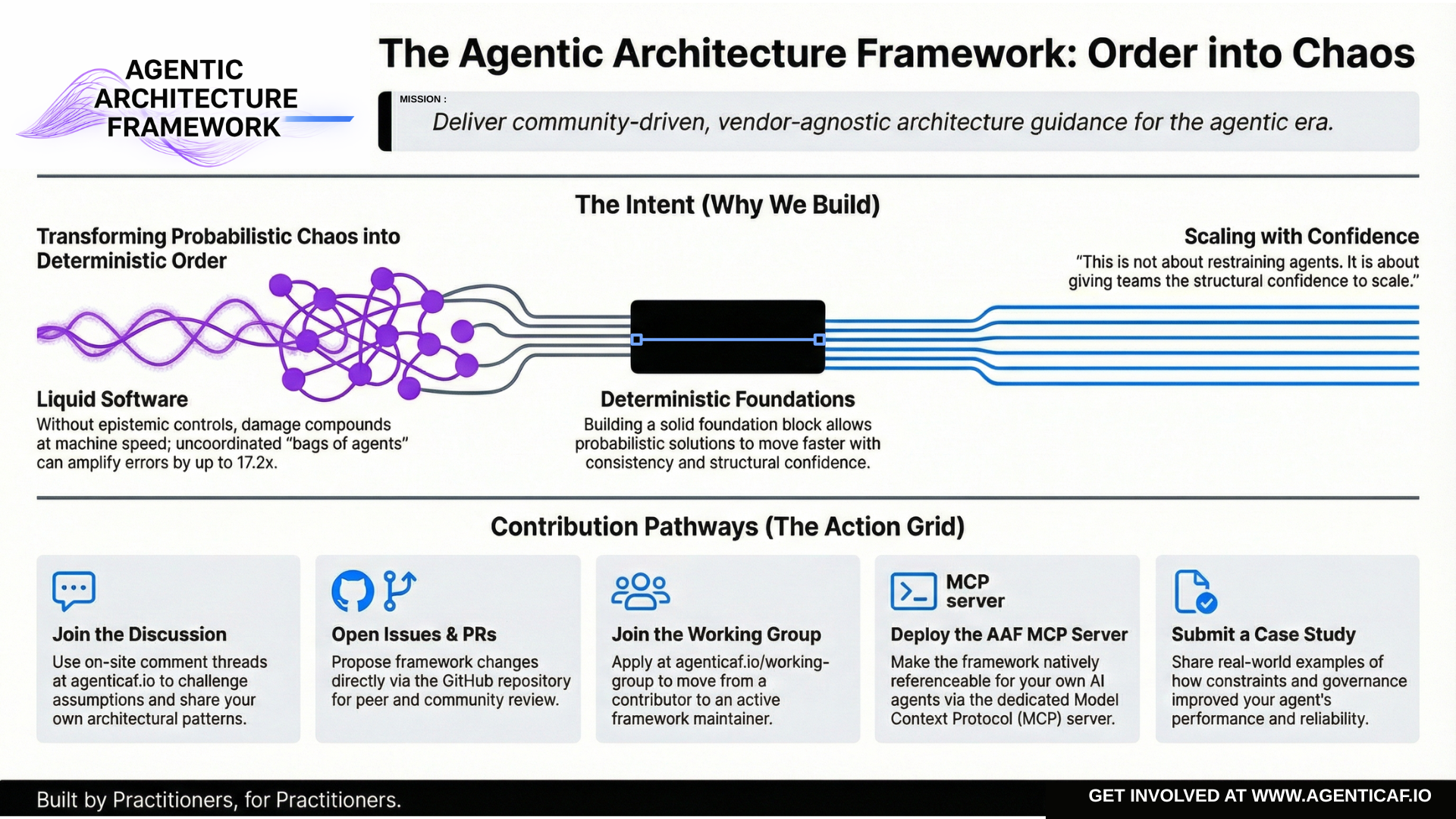
Deliver community-driven, vendor-agnostic architecture guidance for the agentic era.
How to contribute
- Join the discussion — every page on this site has a comment thread. Challenge assumptions, share patterns, flag gaps.
- Open issues and PRs — propose changes directly in the GitHub repo. All contributions are reviewed by the community.
- Join the working group — apply at agenticaf.io/working-group to become a maintainer. See the Terms of Reference and current members.
- Spread the word — tell your colleagues, and tell your agents. The framework is available via the AAF MCP server so your AI tools can reference it natively.
- Submit a case study — built something that validates (or challenges) the framework? Submit it via the case study template and it may be included as a section-aligned case study in the framework.
The intent behind this framework
Agents multiply. The foundations they build on multiply with them. If those foundations are unsound — shaped by vendor lock-in, marketing narratives, or unchallenged assumptions — the damage compounds at machine speed. We need shared, practitioner-led guidance that helps teams reason, design, and govern agentic systems with confidence.
Software is now liquid — reshaped continuously by agents operating faster than any human review cycle. The true constraint on agentic systems is not the models; it is whether epistemic controls can keep pace with the autonomy we grant. We are building deterministic foundations so that probabilistic agentic solutions can move faster, with consistency and accuracy, not slower. This is not about restraining agents. It is about giving them — and the teams behind them — the structural confidence to scale.
I'm writing this as a practitioner who has spent years operating at the boundary between conceptual architecture and production reality — first as an enterprise cloud architect, and more recently as an AI solution architect. This document is the accumulation of ideas, patterns, and controls captured while designing and delivering large-scale systems across enterprise environments, then stress-testing those principles against the distinct failure modes of AI and agents. The startups I have built have accelerated that learning curve, forcing repeated engagement with the topics where cost, security, reliability, and operational control stop being theoretical and become immediate.
The future is already here. Please take this for what it is: a Version 1 framework intended to help you deliver better agents — a structure to support clearer thinking, safer design, and more repeatable outcomes. Feedback, challenge, and counterexamples are not just welcome; they're necessary. In this space, the moment something is written, it starts to go out of date. The hope is that this artifact earns its place as a stable reference point: a way to learn, compare approaches, and introduce order into the fast-moving agentic landscape.
To get to the moon, first you have to get out of bed. This is v1.
Dave